

Tech Giants Envision Future Beyond Smartphones
Your smartphone isn’t going anywhere tomorrow. But the biggest names in tech no longer treat it as the finish line Techscopedaily.
Apple, Google, Meta, Samsung, and even OpenAI are quietly building the next chapter of personal computing. That chapter looks less like a screen and more like something you wear, or barely notice at all.
This shift isn’t marketing spin. It’s a response to a real problem: the smartphone market has matured, upgrade cycles have slowed, and innovation inside that glass rectangle has flattened out. So tech giants envision a future beyond smartphones as the natural next move, backed by billions of dollars in research, acquisitions, and manufacturing deals.
This article breaks down what’s happening, which companies are leading, what’s still just a rumor, and what it means for your next tech purchase.
Why Tech Giants Are Looking Beyond Smartphones
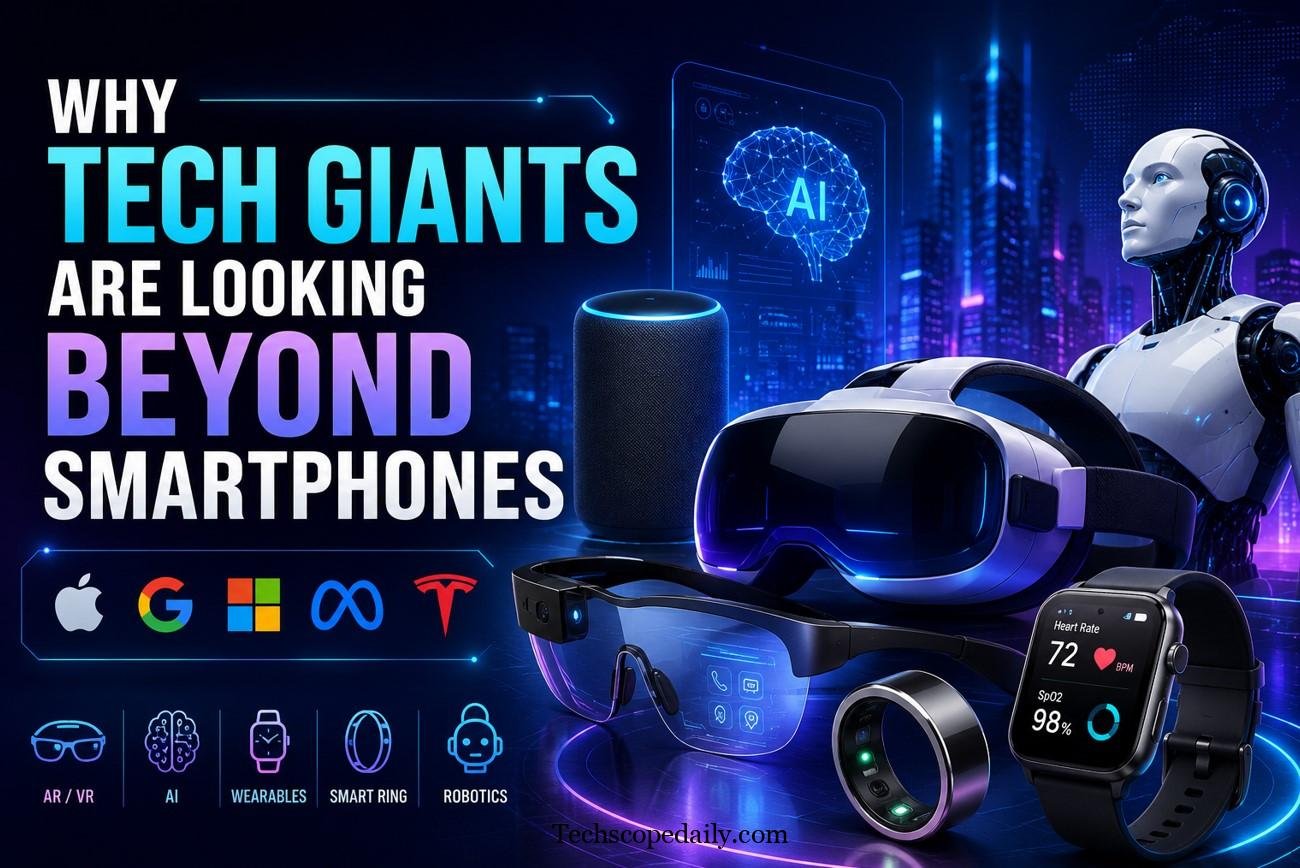
Smartphone shipments are flattening out worldwide. People are keeping their phones longer, often two to three years instead of the old annual upgrade habit. Average prices have climbed as component costs rise, which only reinforces the trend.
That’s not a growth story. It’s a plateau. And every major tech company reads the same data.
A few forces are pushing the industry toward something new:
- On-device AI is now powerful enough to run without constant cloud access, which opens the door to smaller, smarter gadgets.
- Battery and chip efficiency have improved enough to support all-day wearable devices.
- Display technology, like micro-LED and waveguide optics, is finally compact enough to fit into glasses instead of headsets.
- Consumer fatigue with staring down at screens has created demand for hands-free, “eyes-up” interaction.
None of this means the smartphone disappears. It means the smartphone stops being the only device that matters. Instead, it becomes the hub, while lighter, more specialized gadgets handle everyday tasks.
The Smart Glasses Race Explained

If there’s one product category defining this shift, it’s smart glasses. Nearly every major player has placed a bet here, and the reasons are simple.
Glasses sit on your face. That means they can see what you see and hear what you hear, without you pulling anything out of your pocket. Combine that with a capable AI assistant, and you get a device that can translate a menu, identify a landmark, or answer a question, all without a single tap.
Why Glasses Beat Other Wearables
Smartwatches and earbuds already exist, but they’re limited. A watch has a tiny screen. Earbuds have no visual input at all. Glasses solve both problems at once, offering audio, camera input, and sometimes an in-lens display, all in a familiar, socially acceptable shape.
That’s why Meta’s glasses, built in partnership with Ray-Ban’s parent company EssilorLuxottica, have become the most commercially successful product in this category so far. Sales have grown sharply year over year, driven largely by the fact that the glasses simply look like normal eyewear.
The Display Question
Not every company agrees on how much a pair of smart glasses should show you. Some brands are betting on audio-first designs with no screen at all, prioritizing comfort and battery life. Others are pushing toward in-lens displays that show live captions, directions, and translated text right in your field of vision.
This split matters because it shapes battery life, price, and comfort. A glasses design with a display needs more power and more processing, while an audio-only design can run lighter and cheaper.
Who’s Doing What: A Company-by-Company Breakdown
Meta: The Volume Leader
Meta has the biggest head start. Its Ray-Ban partnership has already sold millions of units, and the company has expanded into other eyewear brands to widen its reach. Meta’s CEO has publicly described glasses as the ideal hardware form for AI.
Apple: The Careful Follower
Apple hasn’t shipped standalone smart glasses yet, but it’s reportedly testing multiple frame designs. True to its usual pattern, Apple enters categories after competitors prove demand, then resets expectations with tighter design. Its huge base of active iPhone users gives it a distribution edge smaller rivals lack. Leadership changes on its wearable team, though, have raised doubts about its timeline.
Google: The Software and Ecosystem Play
Google has moved from prototypes to a real product, launching AI-powered glasses built around its Gemini assistant, and partnering with eyewear brands for style credibility. Its real advantage isn’t hardware, it’s software: strong AI models and a shared Android XR platform that partners can build on.
Samsung: The Price Disruptor
Samsung has taken a different approach with a headset priced at roughly half of Apple’s premium spatial computing device, while running on that same Android XR platform. The strategy is simple: undercut on price and lean on Android’s existing app ecosystem.
OpenAI: The Wildcard
OpenAI’s acquisition of a hardware design studio, led by a former Apple design executive, signals serious intent to build a device of its own. Reports point toward a simpler, speaker-like AI companion rather than glasses.
Chinese Manufacturers: The Fast Followers
Companies like Xiaomi and XREAL are moving quickly, prioritizing lightweight design over flashy displays, then adding smarter AI features and better screens over time.
Comparison Table: Post-Smartphone Devices in 2026
| Device Type | Leading Companies | Core Strength | Main Limitation |
| Camera + AI Glasses | Meta, Xiaomi | Style, social acceptance, strong sales | Limited display, battery life |
| Display Glasses | Google, Samsung, Apple (upcoming) | Live captions, navigation, translation | Higher cost, more power drain |
| Spatial Computing Headsets | Apple, Samsung | Full immersive experience | Bulky, expensive, indoor use only |
| Audio-Only Smart Glasses | Independent brands | Comfort, all-day wear, privacy-friendly | No visual features |
| AI Pins and Speakers | OpenAI, early startups | Simplicity, low friction | Unproven category, service dependency |
This table shows a market still figuring itself out. No single format has won yet, and each option trades off something important, whether that’s price, comfort, or capability.
Ambient Computing: The Bigger Idea Behind the Hardware
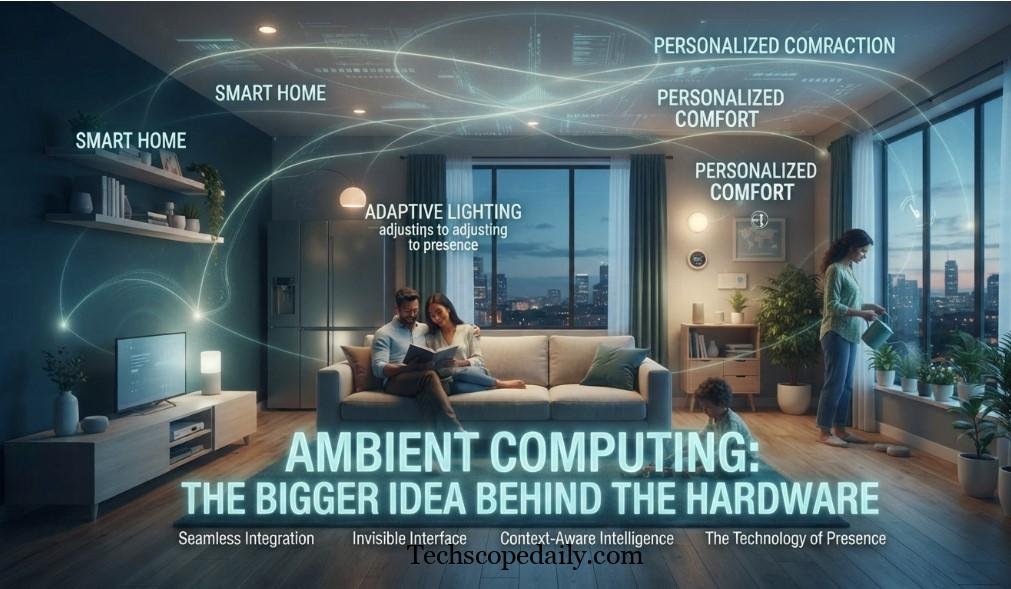
Behind all this hardware sits a bigger concept: ambient computing. This is the idea that technology should fade into the background instead of demanding your full attention.
Instead of opening an app to check the weather, an ambient system tells you before you leave the house. Instead of typing a question, you simply ask out loud and get an answer through your earbuds or glasses.
This concept isn’t new. Voice assistants tried to deliver it years ago but lacked the intelligence to feel useful. Modern AI models change that, since they understand context and respond in natural language.
The end goal isn’t a single killer device. It’s an ecosystem, glasses, earbuds, watches, and the phone itself, working together so no single screen has to do all the work.
Learn More: Software GDTJ45 Builder Problems
Pros and Cons of a Post-Smartphone Future
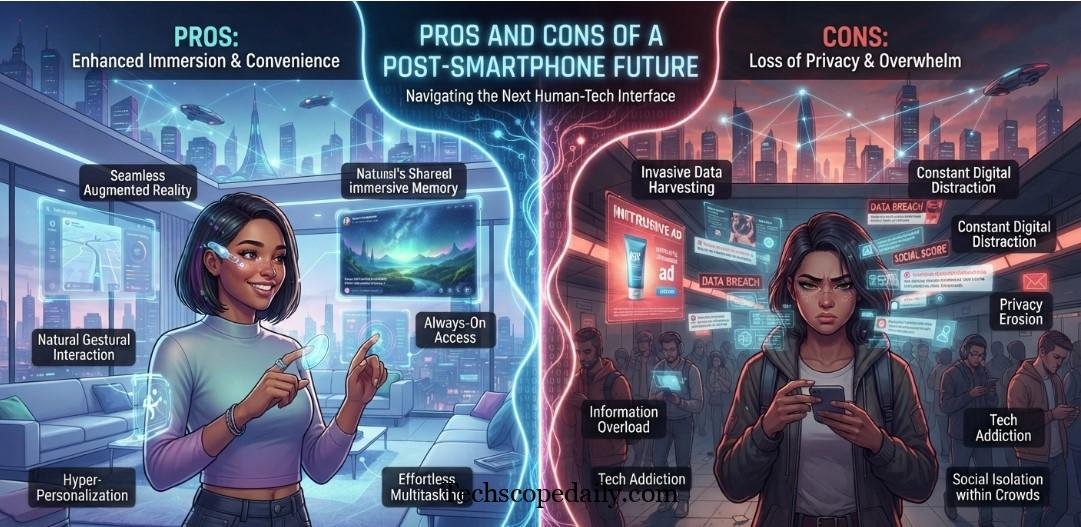
Pros
- Hands-free convenience: Tasks like navigation, translation, and quick questions no longer require pulling out a phone.
- Faster access to information: Ambient AI can answer questions before you even finish asking them.
- New accessibility options: Voice-first and glasses-based interfaces can help people who struggle with small touchscreens.
- Reduced screen fatigue: Less time looking down at a phone could mean more presence in the physical world.
- Business opportunity and innovation: Competition between companies is speeding up genuine improvements in battery life, AI accuracy, and design.
Cons
- Privacy concerns: Camera-equipped glasses raise real questions about consent and surveillance in public spaces.
- High cost of premium devices: Spatial computing headsets remain expensive, limiting mainstream adoption.
- Battery limitations: Powering cameras, displays, and AI processing all day is still a technical challenge.
- Social acceptance: Not everyone is comfortable wearing camera-equipped devices in public, or being recorded by someone else’s.
- Fragmented ecosystem: With so many competing platforms, buyers risk investing in a format that doesn’t stick around long-term.
Privacy and Regulation: The Elephant in the Room

Camera-equipped smart glasses have already triggered real regulatory attention. Some regions treat wearable visual AI as a higher-risk category, requiring stricter rules around recording and facial recognition features.
Institutions like schools, hospitals, and corporate offices are also setting their own restrictions on camera-equipped wearables, regardless of what national regulators decide.
This is pushing some companies toward a different strategy. A handful of newer glasses brands have skipped cameras altogether, betting that “no camera” becomes a selling point for buyers who want an assistant without the surveillance baggage.
Expect this tension to shape the market for years. Privacy concerns slowed earlier waves of tech adoption, like social media, but rarely stopped them entirely. The likely outcome is targeted regulation on specific features, not a ban on wearable AI as a whole.
What This Means for You Right Now

You don’t need to replace your phone today. Nothing shipping in 2026, and likely not in 2027 either, is close to fully replacing what a smartphone does for most people.
That said, a few practical takeaways are worth keeping in mind:
- If you’re curious about AI glasses, wait for pricing to settle. Competing companies are aiming for a similar price range, and more choices should bring costs down.
- If you’re eyeing a spatial computing headset, know that these remain a niche, premium category for now, better suited to enthusiasts than everyday users.
- If your current phone still works fine, holding onto it longer is a reasonable choice, not a sign that you’re falling behind.
- If privacy matters to you, look closely at camera indicators, data policies, and whether recordings are processed on-device or sent to the cloud.
The transition beyond smartphones will likely take years, not months. But the direction is clear, and it’s worth understanding now so you’re not caught off guard later.
Read More: Software Gdtj45 Builder Does Not Work
Frequently Asked Questions
1. Will smartphones disappear completely?
No. Smartphones will likely become one tool among several, similar to how desktop computers didn’t vanish once smartphones arrived.
2. What is the “post-smartphone” future actually called?
Most experts call it ambient computing, a shift toward technology that works in the background instead of demanding constant screen attention.
3. Which company is leading the smart glasses race?
Meta currently holds the largest share of the smart glasses market by sales volume, though Google, Samsung, and Apple are pushing hard to catch up.
4. Are smart glasses safe from a privacy standpoint?
It depends on the device. Cameras, microphones, and facial recognition features raise valid concerns, and regulators in several regions are already reviewing these devices.
5. Do I need a smartphone to use smart glasses?
Yes, in most cases. Current smart glasses rely on a paired smartphone for connectivity and heavier processing, so they act as companions rather than replacements.
6. When will Apple release its own smart glasses?
Apple is reportedly targeting late 2026 to 2027, though leadership changes on its wearable team have added uncertainty to that timeline.
7. What’s the difference between AR glasses and VR headsets?
AR glasses overlay digital information onto the real world while keeping you aware of your surroundings. VR headsets fully immerse you in a simulated environment.
8. Are AI pins a real alternative to phones?
Not yet. Earlier AI pin devices struggled with reliability and leaned heavily on cloud services. Newer attempts may improve, but the category remains unproven.
9. Why are tech giants investing so heavily in this shift now?
Smartphone sales have plateaued, and on-device AI is finally capable enough to power smaller, smarter devices. Companies see this as the next major computing platform.
10. Should I buy AI glasses right now?
If you’re comfortable with first-generation limitations, stick to major, established brands. If you’d rather wait for the market to mature, holding off a year or two is reasonable.
Conclusion
The phrase “tech giants envision a future beyond smartphones” isn’t just a headline. It reflects a real, well-funded shift happening across the entire industry right now.
Meta is winning on volume. Apple is playing its usual patient game. Google is leaning on software and partnerships. Samsung is competing on price. And newer players, from OpenAI to Chinese manufacturers, are testing entirely different form factors.
None of this replaces your phone overnight. But the direction is set, and the next decade of personal technology will likely look a lot less like a screen in your pocket and a lot more like an assistant that simply understands the world around you.
Whatever shape it takes, one thing is certain: the smartphone’s decade-long reign as the center of personal tech is no longer guaranteed. And the biggest companies in the world are racing to decide what replaces it.