

Louisiana Abbreviation: LA vs. La. and When to Use Each
If you’ve ever addressed an envelope, filled out a government form, or written a school paper about the Pelican State, you’ve probably paused and wondered which Louisiana abbreviation is actually correct.
Is it “LA”? Is it “La.”? Does it change depending on where you’re writing it?
The short answer is that Louisiana has more than one accepted abbreviation, and each one belongs in a different context. Using the wrong one on a mailing label, resume, or academic paper can look careless, and in rare cases it can even cause mail delays.
This guide breaks down every version of the Louisiana abbreviation, explains exactly when to use each one, and covers related details like parish codes, area codes, and time zone shorthand that people often search for alongside this topic. By the end, you’ll never have to second-guess it again.
What Is the Official Louisiana Abbreviation?
The official postal abbreviation for Louisiana is LA, written in two capital letters with no period. This is the version set by the United States Postal Service (USPS) as part of its two-letter state code system, which was introduced in the 1960s to speed up mail sorting.
Every U.S. state, territory, and the District of Columbia has one of these two-letter codes. Louisiana’s is simply “LA,” matching the first two letters of the state’s name.
You’ll see “LA” used in:
- Mailing addresses
- Government databases and tax forms
- Driver’s license records
- E-commerce shipping fields
- Vehicle registration paperwork
This two-letter version is the one people mean 95% of the time when they search for “Louisiana abbreviation,” and it’s the one you should default to unless you have a specific reason to use something else.
LA vs. La.: What’s the Difference?

Here’s where confusion usually starts. Louisiana actually has two legitimate abbreviations, and they aren’t interchangeable.
1. LA (USPS Style)
- Two capital letters
- No period
- Used only in mailing addresses and postal contexts
- Required by USPS formatting rules
2. La. (Traditional/AP Style)
- Capital “L,” lowercase “a,” followed by a period
- Used in formal writing, journalism, and traditional style guides
- Common in books, newspapers, and academic citations before digital formatting became standard
The Associated Press (AP) Stylebook, which many U.S. newspapers and news websites follow, traditionally used “La.” for Louisiana in body text, not “LA.” This distinction matters if you’re writing for publication, since editors trained in AP style will flag “LA” as incorrect outside of an address block.
Rule of thumb: Use “LA” for addresses and forms. Use “La.” for narrative writing, unless your style guide says otherwise.
USPS Rules for Abbreviating Louisiana
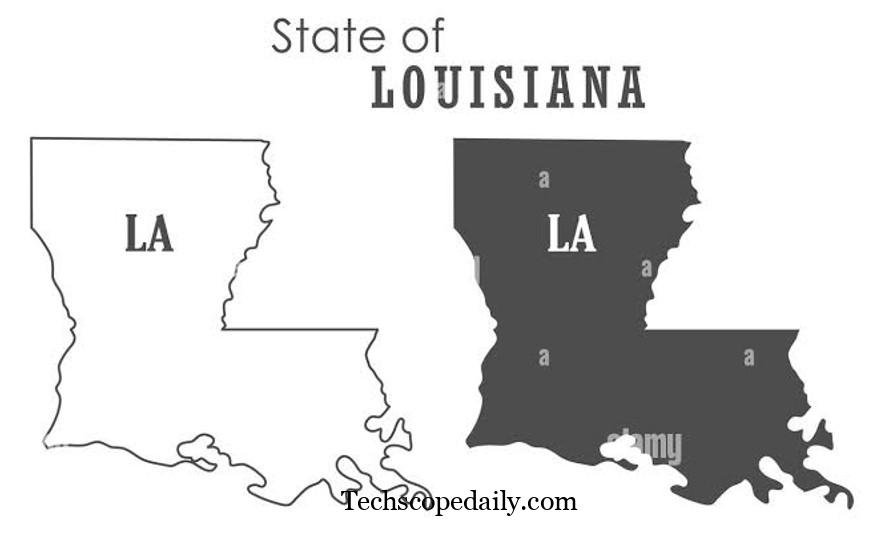
The United States Postal Service has strict formatting expectations for addresses, and getting them right actually does matter for delivery speed.
According to USPS addressing standards, state abbreviations should:
- Always appear in all capital letters
- Never include a period
- Be placed directly after the city name, separated by a comma
- Be followed by the five- or nine-digit ZIP code
A properly formatted Louisiana address looks like this:
1200 Poydras St
New Orleans, LA 70112
Notice there’s no period after “LA” and no extra punctuation. This format is optimized for USPS automated sorting machines, which scan for the two-letter code to route mail correctly.
If you’re filling out any government-issued document, shipping label, or online checkout form, “LA” without a period is the safe, correct choice every time.
Louisiana Abbreviation Comparison Table
| Abbreviation | Format | Where It’s Used | Period Included? |
| LA | Two capital letters | Mailing addresses, USPS, government forms, shipping labels | No |
| La. | Capital + lowercase + period | Journalism, formal writing, older reference books | Yes |
| Lou. | Rare, informal | Casual writing, historical documents | Sometimes |
| LOUIS | Not standard | Occasionally seen in old ledgers or manual records | No |
Only “LA” and “La.” are considered current, correct abbreviations. The others are either outdated or nonstandard and shouldn’t be used in professional or official contexts.
Why Louisiana Uses “Parishes” Instead of Counties
While it’s not technically part of the state abbreviation itself, this is one of the most-searched related topics, so it deserves a clear explanation here.
Louisiana is the only U.S. state that calls its county-level divisions parishes instead of counties. This dates back to the state’s early history under French and Spanish colonial rule, when local government boundaries were organized around Catholic church parishes rather than secular county lines.
When Louisiana joined the Union in 1812, it kept the parish system rather than switching to the county model used elsewhere. Today, Louisiana has 64 parishes, and each one has its own three-digit FIPS code used in census data, election records, and federal databases.
This matters for the abbreviation topic because people often confuse “parish abbreviations” with the “state abbreviation.” They are two completely separate systems:
- State abbreviation: LA (applies to the whole state)
- Parish codes: Numeric FIPS codes, not letter abbreviations, used for individual parishes like Orleans, Jefferson, or Caddo
A Brief History of How Louisiana Got “LA”
Understanding where the two-letter code came from makes it easier to remember why the format is so strict today.
Before the 1960s, states didn’t have a standardized abbreviation system. Writers used whatever shorthand felt natural, which meant Louisiana might appear as “La.,” “Lou.,” or even spelled out in full on official mail. This inconsistency made manual mail sorting slow and error-prone, especially as the volume of mail across the country kept growing.
In 1963, the USPS introduced ZIP codes to speed up sorting and delivery. To make the system work efficiently, the agency also rolled out a matching set of two-letter state codes designed to be scanned and processed by early sorting machines. Louisiana received “LA,” based simply on the first two letters of its name, the same logic used for most states.
A handful of states needed different logic because their first two letters overlapped with another state. Louisiana didn’t have that problem, so its code has remained “LA” without changes since the system launched.
This is also why the postal code and the traditional AP abbreviation never fully merged into one format. AP style had already been in use by newspapers for decades before USPS created its system, so publications kept their existing “La.” convention for body text while adopting “LA” only within printed addresses.
Today, this dual system still shapes how people write the state’s name, which is exactly why so many people search for clarification on which version to use.
Common Mistakes People Make
Even experienced writers slip up on this one. Here are the errors seen most often:
- Confusing LA (Louisiana) with L.A. (Los Angeles). This is by far the most common mistake. Context always resolves it, but it can cause real confusion in headlines or short-form writing without added context.
- Adding a period to the postal code. Writing “LA.” on an address is technically incorrect USPS formatting.
- Using lowercase letters in addresses. USPS systems expect uppercase “LA,” not “la” or “La” on the address line.
- Mixing styles within the same document. Switching between “LA” and “La.” in the same piece of writing looks inconsistent and unpolished.
- Assuming AP style rules apply to addresses. AP style governs narrative text, not postal formatting. The two systems don’t overlap.
Pros and Cons of Each Abbreviation Style
LA (Postal Style)
Pros:
- Universally recognized by shipping and mailing systems
- Required for USPS delivery accuracy
- Consistent across all 50 states, so it’s easy to remember
- Standard in digital forms, databases, and checkout fields
Cons:
- Easily confused with “Los Angeles” outside of an address context
- Looks out of place in formal narrative writing
La. (Traditional/AP Style)
Pros:
- Preferred in journalism and traditional publishing
- Reduces confusion with “Los Angeles” since the format is visually distinct
- Matches historical and academic reference conventions
Cons:
- Not accepted by USPS for addresses
- Increasingly rare as more outlets move away from strict AP style in digital content
- Some younger readers find the period-based format unfamiliar
Other Louisiana Shorthand You Should Know
Beyond the core abbreviation, a few related shorthand terms come up often in searches and everyday use.
- Area codes: Louisiana uses several area codes, including 225 (Baton Rouge), 504 (New Orleans), 337 (Lafayette), and 318 (Shreveport).
- Time zone: Louisiana operates on Central Time (CT), sometimes abbreviated as CST or CDT depending on the season.
- Vehicle abbreviation: On older maps and some vehicle registration contexts, you may still see “LA.” used informally, though it’s not an official standard.
- Sports and media shorthand: Local news outlets sometimes use “La.” in headlines to save space while keeping AP style consistency.
Knowing these related codes helps when you’re filling out multi-field forms that ask for state, area code, and time zone information all at once.
FIPS and Census Codes
Government databases also assign Louisiana a numeric FIPS code (22), which is different from both “LA” and “La.” This code is used mainly in census records, federal statistics, and data processing systems rather than everyday writing. If you’re working with spreadsheets or datasets that reference states numerically, “22” is the code you’re looking for, not a letter abbreviation at all.
Airport and Transportation Codes
Louisiana’s major airports also have their own three-letter codes, which are sometimes mistaken for a state abbreviation. MSY refers to Louis Armstrong New Orleans International Airport, while SHV and BTR cover Shreveport and Baton Rouge. These codes are assigned by the International Air Transport Association (IATA) and have nothing to do with the state’s postal abbreviation, but they frequently appear in the same searches because people are booking travel and filling out address fields at the same time.
License Plate and DMV References
Louisiana’s Department of Motor Vehicles uses “LA” consistently across registration stickers, title paperwork, and license formats, matching the USPS standard. This consistency across government agencies is intentional. It reduces errors when data gets shared between the postal service, DMV systems, and federal databases.
How to Use “LA” Correctly in a Sentence
Since context is everything with this abbreviation, here are a few clean examples:
- Address format: “Please ship the order to Shreveport, LA 71101.”
- Formal writing (AP style): “The hurricane made landfall near Lake Charles, La., early Tuesday morning.”
- Casual writing: “We’re driving through Louisiana this weekend, probably staying in Baton Rouge.”
Notice that in casual or conversational writing, many people simply spell out “Louisiana” instead of abbreviating it at all, especially outside of forms and addresses. That’s a perfectly acceptable choice when clarity matters more than brevity.
Frequently Asked Questions
1. What is the two-letter abbreviation for Louisiana?
The official two-letter USPS abbreviation for Louisiana is LA, written in capital letters with no period.
2. Is “La.” or “LA” correct for Louisiana?
Both are correct, but they serve different purposes. “LA” is used for postal addresses and official forms, while “La.” is used in traditional AP-style journalism and formal writing.
3. Why is Louisiana’s abbreviation the same as Los Angeles?
Louisiana’s postal code “LA” happens to match the common shorthand for Los Angeles, but they are unrelated. Context, such as a ZIP code or surrounding text, always clarifies which one is meant.
4. Does Louisiana’s abbreviation ever include a period?
Only the traditional “La.” format includes a period. The USPS postal code “LA” never includes one.
4. What abbreviation should I use on a resume or business document?
Use “LA” without a period, since it matches standard address formatting expected in professional documents.
6. Is there a three-letter abbreviation for Louisiana?
No official three-letter abbreviation exists for Louisiana. Some older records use “Lou.” informally, but it is not a recognized standard.
7. What is Louisiana’s abbreviation used for besides mail?
Beyond addresses, “LA” appears on driver’s licenses, tax documents, vehicle registrations, and most government or e-commerce database fields.
8. Do other countries recognize “LA” as Louisiana’s abbreviation?
International postal systems generally recognize U.S. state codes like “LA” when mail includes “USA” or “United States” in the address, since USPS standards apply specifically within domestic routing.
9. What is the difference between a state abbreviation and a parish code?
A state abbreviation like “LA” refers to the entire state, while parish codes are numeric identifiers used for Louisiana’s 64 individual parishes, which function like counties in other states.
10. How can I remember which abbreviation to use?
A simple rule: use “LA” for anything official, digital, or address-related, and use “La.” only if you’re writing in a strict AP-style publication.
Conclusion
The Louisiana abbreviation isn’t as simple as a single two-letter code, even though “LA” covers most everyday needs. Understanding the difference between “LA” for postal and official use and “La.” for traditional journalistic writing helps you avoid small but noticeable mistakes in addresses, resumes, and formal documents.
Keep it simple: default to “LA” for anything official or digital, reserve “La.” for narrative writing under AP style, and always double-check context when the abbreviation could be confused with Los Angeles. With that distinction clear, you’ll format Louisiana correctly every single time.


